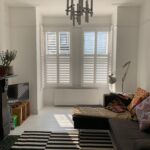









Georgian, Regency, Edwardian and Victorian: the UK is home to a wonderful range of period properties. Of all of these, the Victorian terrace and villa is one of the most common styles you’ll find across London and the South East, instantly recognisable by its tall sash windows and elegant bay frontage.
If you own a Victorian property, you’ve probably already wondered how to dress those large bay windows without losing the character that makes the house special. The answer, for thousands of homeowners, is bay window shutters, and Victorian properties happen to suit them better than almost any other architectural style.
Why choose Victorian bay window shutters?
Bespoke and made to measure, plantation shutters look superb in Victorian bay windows. Each shutter is built panel-by-panel to fit the unique angles of a bay, so there’s no need for the bulky pelmets or awkward curtain tracks that period bays so often demand.
Beyond the look, there are practical reasons they suit older homes so well:
- Light and privacy control: adjustable louvres let you angle light exactly how you want it, room by room, hour by hour.
- Insulation: an extra layer of timber or composite across the glass helps retain heat in draughty Victorian sash windows and can ease the load on your heating bills.
- Durability: unlike fabric blinds or curtains, made-to-measure shutters don’t fade, sag or need replacing every few years.
- Kerb appeal: from the street, a neatly shuttered bay is one of the most recognisable hallmarks of a well-kept period home.
If you’d like to see how the numbers work out for your own windows, our online price estimator gives you a free, instant guide before you commit to anything.
What style of shutter suits a Victorian bay?
Choosing the right configuration is half the job. Because a Victorian bay is really three (or sometimes five) separate window sections meeting at angles, the way the shutters are built into that space matters more than it does on a single flat window. All of our shutter styles can be tailored to a bay, but three options come up again and again with our Victorian customers:
Café style shutters cover only the lower half of the window. They’re a favourite for Victorian bays that face directly onto the street, since they give you privacy from passers-by at eye level while still letting light flood in through the uncovered top half.
Tier-on-tier shutters split each panel into two independently opening sections, so you can open the bottom for privacy and the top for light, or vice versa. This split-control is especially useful in a bay, where the same window often needs to do two jobs at once: for example, a living room bay that wants daylight up high but a closed lower half when you’re sitting in.
Solid shutters use solid panels rather than louvres, blocking light out completely when closed. They give Victorian bays a bold, characterful look and are popular in bedrooms or anywhere privacy matters more than ventilation.
If you’re undecided, our full range of shutter styles walks through every configuration we offer, including full height, folding and hinged designs that can all be adapted to a bay window’s angles.
Which room is the bay in?
The right shutter style often comes down to which room you’re dressing:
- A bay in the living room usually benefits from tier-on-tier or café style shutters, balancing natural light with street-level privacy.
- A kitchen bay, often used for a breakfast nook, suits café style shutters that keep the worktop bright while screening the lower half.
- A bedroom bay tends to call for solid or full height shutters, where blocking out light completely is the priority.
What about colour?
Colour is where you can really tie your shutters into the wider character of a Victorian home. White window shutters are the classic choice: timeless, bright, and in keeping with the heritage palette found in most period properties.
For a warmer, more traditional finish, natural hardwood and wood-stain finishes echo the original timber sashes and skirting found in most Victorian houses. Take a look at our full shutter colours range and our guide to shutter materials to find the finish that will work best with your existing woodwork.
Not sure shutters are right for you?
If you’re still weighing up your options, two of our guides might help: are window shutters worth it? covers the real-world pros, cons and costs, while do shutters make a room look bigger? looks specifically at how shutters affect the feel of a space, a common question for bay windows in particular, since they can visually extend a room outward.